Off-Site Program: An Evening with Ellen Pau at MoMA
Mon, May 18, 2026, 7pm





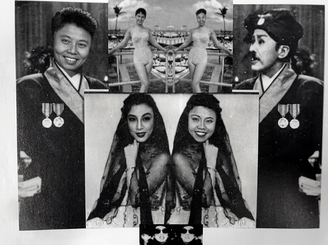
Portrait of Ellen Pau, detail. Photo: Luo Jr-Shin
Off-Site Program at the Museum of Modern Art
On the occasion of her survey exhibition Ellen Pau: She Moves at SculptureCenter, Hong Kong–based artist Ellen Pau joins MoMA to present a program of experimental video work made in Hong Kong from the 1980s to the present. A self-taught artist and radiographer by training, Pau has continually pushed the boundaries of visual language by experimenting with evolving technologies to examine Hong Kong’s cultural milieu and urban transformation. Her early engagement with film and video grew from collaborations with the experimental theater company Zuni Icosahedron (1982–present) and participation in Phoenix Cine Club (founded in 1973). As cofounder of Videotage in 1986, Pau has played a key role in shaping Hong Kong’s video-art ecosystem.
The selections in this program reflect Hong Kong’s distinctive media ecology and shifting political landscape. Pau’s TV Game of the Year (1989) stages a “Simon Says” video game with former PRC Premier Li Peng as the leader, while Cheng Chi-hung and Mak Chi-hang’s East Is Red (1993) channels this air of irony through a revolutionary song and image as attention shifts from the events of 1989 to the new horizon of 1997. Lee Kit’s I Think You’re Crazy (2017) subtly alludes to a more recent political conflict surrounding the omnipresent, seemingly mundane window air conditioner unit.
Questions of gender, sexuality, and postcolonial subjectivity surface through repurposed images read against the grain. Made after the Sino-British Joint Declaration of 1984, May Fung’s She Said Why Me (1989) combines performance and archival footage to examine women’s presence in postcolonial public space. Pau’s Song of the Goddess (1992) montages televised performance footage to memorialize two leading female Cantonese opera performers known as lovers both on and off-screen, while in Walking to Nam Kok Hotel (2018), Lau Wai assembles cinematic representations of Hong Kong to illustrate how colonial sexual politics and orientalism continue to shape imaginations of the city.
Other works highlight artists’ explorations of the video medium itself. In Love in the Time of Cholera (1988), Pau experiments with early consumer video technology while subtly alluding to illicit queer desire. Henry Chu’s TV Clock (2005), originally presented as a site-specific installation, investigates inattentive spectatorship, organising the flow of televised images as a way of keeping time. In Sonata for Smoke (2020, revised 2021), Samson Young explores the directionality of time through the shared ephemerality of sound and smoke.
TV Game of the Year. 1989. Hong Kong. Directed by Ellen Pau. 5 min.
East Is Red. 1993. Hong Kong. Directed by Cheng Chi-hung, Mak Chi-hang. 2 min.
I Think You’re Crazy. 2017. Hong Kong. Directed by Lee Kit. 3 min. Courtesy the artist and Mother’s tankstation
She Said Why Me. 1989. Hong Kong. Directed by May Fung. 8 min.
Song of the Goddess. 1992. Hong Kong. Directed by Ellen Pau. 7 min.
Walking to Nam Kok Hotel. 2018. Hong Kong. Directed by Lau Wai. 3 min. Courtesy the artist
Love in the Time of Cholera. 1988. Hong Kong. Directed by Ellen Pau. 4 min.
TV Clock. 2005 (single-channel version, 2026). Hong Kong. Directed by Henry Chu. 2 min. Courtesy the artist
Sonata for Smoke. 2020 (revised 2021). Hong Kong. Directed by Samson Young. 16 min. Courtesy the artist
Program approx. 50 min.
Unless noted, all titles courtesy Videotage
Tickets for non-MoMA members become available May 11, members can reserve tickets starting May 4.