Close

    Pat Oleszko: Fool Disclosure

    Pat Oleszko: Fool Disclosure

    Jan 29–Apr 27, 2026

    • Images
    • Text
    • Events
    • Press
    • Sponsors
    • Related

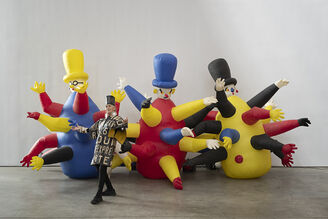
    SculptureCenter presents the first solo exhibition in a New York City institution in over 35 years of Pat Oleszko. Rooted in humor, sharp social commentary, and the defiance of all forms of authority, Oleszko's sculptures lend themselves to raucous performances that use linguistic wit to address concerns about the state of the world. As her work developed, Oleszko devised some defining strategies: using her body, which led to costumes, and using air, which produced large inflatable works. In both cases, her art “walked out the door,” in her words, “using all the world as a stooge.”

    Spanning SculptureCenter’s two floors, Fool Disclosure is constructed around Oleszko’s singular inflatables, which first appeared in the 1980s, and brings together dozens of these airy, monumental works for the first time. Blowhilda (1980), one of the earliest, showed her the material’s potential to grow exponentially and shrink in size within a matter of seconds, making it easy to transport and add to performances, from street to stage. Other early inflatables include Big Pussy (1989), an homage to her mentor in burlesque Rose La Rose, and The Domino Effect (1990), made after she was in Berlin around the fall of the wall. More recent works include WarUSaurUs, 3 Miss Ills, and General Dismay from the Deportment of Corrections (2007), made in response to George W. Bush’s war in Iraq. Altogether, the works gathered demonstrate Oleszko’s place as a modern-day jester with a distinctive blend of satire, humor, and subversion.

    Archival displays of posters, postcards, and photographs and intricately handcrafted costumes, shoes, jewelry, and hats—the basis of a series of characters often reassembled for performances, films, or protest—expand on key recurring themes such as the representation of women, political concerns, and climate awareness.

    The exhibition also gathers a selection of Oleszko’s moving image works, of which she produced more than 70 between the 1970s to the 2000s. Many of which feature figures present throughout the exhibition, such as The Handmaiden (1975), which, along with the Coat of Arms (1972), was made for the anniversary of André Breton’s Surrealist Manifesto; Sam Sebastian (1999), a baldly exaggerated American capitalist; and other one-off characters, such as the PATSQUATCH! (1991) made out of pinecones, which stopped traffic and received an emergency visit from the Army Red Cross.

    The presentation will be accompanied by the artist’s first institutional publication, which expands on the performance histories around her sculptures with newly commissioned essays by Columbia University professor and art historian Julia Bryan-Wilson; New York-based cultural worker, writer, and researcher Marie Catalano; Budapest-based curator, writer, and artist Gyula Muskovics; and American chef, food writer—and close friend of Oleszko—Ruth Reichl, along with a biographical timeline by the artist in her own idiosyncratic language. The publication will be designed by Tiffany Malakooti.

    Pat Oleszko: Fool Disclosure is curated by Sohrab Mohebbi, Director, and Jovanna Venegas, Curator, with Sharon X. Liu, Asymmetry Curatorial Fellow. Research assistance by Ray Camp, 2025 Summer Curatorial Fellow.

    Pat Oleszko was born in Detroit (1947). She lives and works in New York City. Oleszko received a BFA from University of Michigan, Ann Arbor. Since the early 1970s, she has staged projects and performances at institutions such as Museum of Modern Art, New York (1976, 1977); The Kitchen, New York (1979, 1992, 1993); Whitney Museum of American Art, New York (1980, 1988), Performance Space 122, New York (1985, 1987, 2000), Museum of Contemporary Craft (now Museum of Art and Design), New York (1971-1990), P.S. 1 (Queens), Lincoln Center, New York (1990), Institute of Contemporary Art, Boston (1989, 2015), Civitella Ranieri, Umbertide, Italy (2019), Neuberger Museum, Purchase, New York (1993, 2019), Rauschenberg Foundation, Captiva, Florida (2016), National Museum of Women in the Arts, Washington D.C. (1991), and King Tut’s Wah Wah Hut, New York; among others. She was the recipient of the Rome Prize in 1998, and the Guggenheim Fellowship in 1990.

    Sponsors

    Generous support for Pat Oleszko: Fool Disclosure is provided by Julie Augur, Girlfriend Fund, and Will Palley. Additional support is provided by Thomas Berger.

    Major support for the Pat Oleszko: Fool Disclosure exhibition catalog is provided by the Eva Hesse Initiative for New Sculpture and the Every Page Foundation. Generous support is provided by David Peter Francis, New York.

    Special thanks to Plaxall, Inc.

    The SculptureCenter Asymmetry Curatorial Fellowship is made possible by Asymmetry.

    Leadership support for SculptureCenter’s exhibitions and programs is provided by Carol Bove, Barbara von Portatius, Anna-Maria and Stephen Kellen Foundation, and Teiger Foundation. Major support is provided by Richard Chang, Jill and Peter Kraus, Miyoung Lee and Neil Simpkins, Eleanor Heyman Propp, Jacques Louis Vidal, and The Andy Warhol Foundation for the Visual Arts. Generous support is provided by Candy and Michael Barasch, Jane Hait and Justin Beal, Gabrielle Humphrey, Amy and Sean Lyons, Alexander S.C. Rower, Lily Lyons, David Maclean, Ronay and Richard Menschel, and Poppy Pulitzer. Additional funding is provided by Ben Ackerley, Charmaine and Roman Mendoza, Matt and Elizabeth Quigley, Katharine Ristich, Julien Sarkozy, Carla Shen, Kristina Wong Foster, and Lisa Young and Steven Abraham.

    Leadership support for SculptureCenter’s annual operations is provided by the Lambent Foundation Fund of Tides Foundation. Major support is provided by Irene and Allen H. Brill, the Hartwig Art Foundation, and the A. Woodner Fund. Generous support is provided by Andrew Fine and David Andersson, Zenas Hutcheson/The Knox Foundation, Marinela Samourkas, our Board of Trustees, and many charitable individuals and friends.

    SculptureCenter’s programming and operations are supported, in part, by public funds from the New York City Department of Cultural Affairs in partnership with the City Council, and made possible by the New York State Council on the Arts with the support of the Office of the Governor and the New York State Legislature.